


By Aruna Stannard | 5 March 2026
Our Wild Pages Writers Residency in November 2025 invited six talented local writers to Felixstowe library for a week to explore the connection between nature and the written word.
Here, writer Aruna Stannard reflects on the week and what it left behind.
Many journeys begin with a walk, and a walk provides a starting point for many journeys. The internet offers one definition of walking which begins: ‘an act of travelling’. Of course, they mean on foot over physical ground, but there are many ways in which we travel: in thoughts, in imagination, in conversations, real or imagined. Darwin, O’Keeffe, Jobs, Woolf: so many, considered visionaries in their fields, used walking as a way into creative thought. Charles Dickens went so far as to say, ‘If I couldn’t walk fast and far, I should just explode and perish.’ Dramatic perhaps, but many of us will recognise that restlessness, and the good things that follow when we take our feet and our thoughts for a wander.
Last November I was fortunate enough to take part in the Wild Pages Writers’ Residency, led by Suffolk Community Libraries in partnership with the Suffolk Wildlife Trust and National Centre for Writing. For one wonderful week, we were based in the library at Felixstowe and encouraged to immerse ourselves in the coastal landscape. I started each morning with a walk from the library, through the town and down onto the seafront. These walks were an exercise in the moment: thinking, noticing. A scavenger hunt that became a poem. This week I returned to retrace my steps, in the hope of unpicking the process and writing my own ‘how-to’ of walking and writing. This is what happened:
On entering this library, any library, a sense of comfort. It’s like letting yourself in with your own key although, of course, the door is already open. There are sofas, nooks, and a general low murmur that speaks welcome. There’s also vibrancy and possibility in the packed noticeboards that peek between the bookshelves. It’s a place that celebrates community and creativity. A cabinet contains sculpted ladybirds, autumn leaves and a neon ice cream. Lego creations, many with ‘Work in Progress’ signs attached, are a proudly displayed reminder that creativity is a process, not a product. A vehicle, twelve bricks high, in primary-coloured stripes catches my eye. The engineer has thoughtfully added a ladder to aid the climb up to the driver’s seat. Lots goes on here, under the watchful eyes of the metal seagulls that adorn the wall near the desk. One in particular, catches my eye. He leans forward, inquisitively. I think he is telling me to get on with it.
Donning gloves against the cold, I turn right and am immediately hit by the smell of the sea. It turns out to be the fishmongers a few doors down, who are selling enormous crevettes, £6 for ten coral question marks dotted with black eyes. A few more rights and I am on Hamilton Road, where I buy coffee. I make a point of looking up and see interesting window casements, stonework swirled with fleur-de-lys and find myself wondering who may have looked out from these windows, what they would have seen, what they would make of the spikes that now adorn these ledges to deter the pigeons. I am briefly concerned for the pigeons, until I notice three tussling over the remnants of a croissant. I side-step these feathered gourmands, buy a croissant and continue.
The gentle downward slope and the sound of seagulls tells my senses I am sea bound. I pass a church whose door is the most beautiful shade of blue. I miss a flame-coloured fungus growing in a barrel, that I will only notice on my return. A drainpipe drips, a local man is running a marathon, I should be able to see the sea by now. It strikes me then, that I can, only today the sea and the sky are colour-matched. The last time I was here, I remember a sea the colour of weak tea. Now, like the sky, it is the palest shimmering grey-blue, colour of snowdrifts. I wonder how an artist would mix it: white, the black dot of a question mark, a splash of church-door blue, a thumbed smudge of silver glitter the only mention of a horizon.
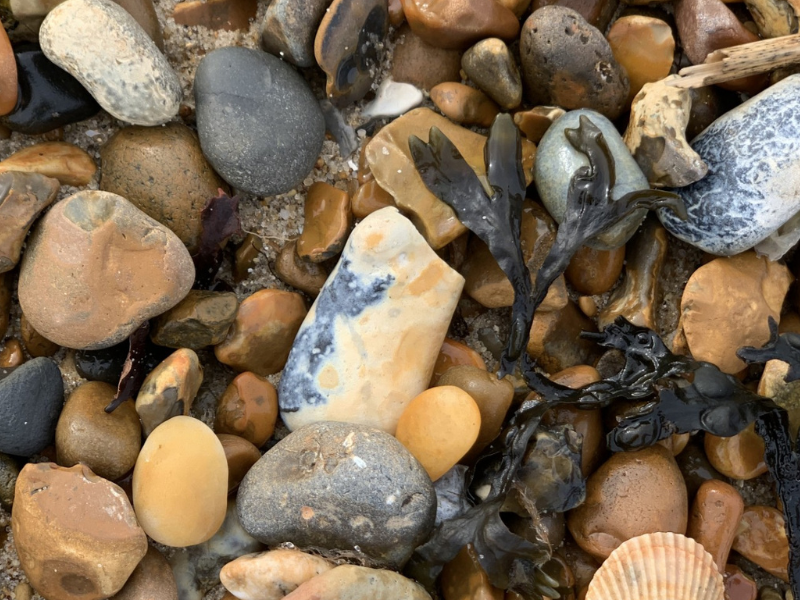
By now, I have forgotten about previous walks and old words. I am staring at what looks like a rubbish heap. At the top of the beach, the sea has dumped a tangled mess against the sharp contrast of concrete. It is so easily ignorable that it demands closer inspection. Dropping down onto the beach, I start to notice the individual things that make up its matter. There are pebbles of course, lots of them, and various grades of grit and sand. And in amongst them, mermaid’s purses, dozens, stiff and leathery. These egg cases of sharks, skates and rays are rectangular in shape with horns or tendrils stretching from each corner. I am suddenly reminded of the ubiquitous facemasks of the pandemic, (was that really 6 years ago?) and feel grateful for the cold air on my uncovered face. The purses are mostly black, but I notice one that is leopard-spotted and jazzy.
Seaweeds, like trees, deserve a closer naming than I am able to give. There are different types of wrack, I think, the tangle of ballooning bladders and fronds gives the appearance of a frenzy of overgrown tadpoles, out of water. I imagine them turning into frogs, green and slimy as sea lettuce, hopping along the promenade. A dry and paler sort flings out wispy fronds like hair in breeze or dancer’s limbs, so much movement in something sitting still. On this beach there are things like brains, yellowing nodular cloud-ish clumps that I will later learn are whelk egg cases, sometimes known as ‘sea wash balls’ or ‘fisherman’s soap’.
Wave-battered shells reveal the secrets of their architecture; the spiral skeleton of a whelk reminds me of a diagram of the anatomy of the ear, that once hung in a classroom of my childhood. A hulled out crab takes me back to the fishmonger’s window. Another fan-shaped shell is striped with the colours of midnight and fire, a mini Turner sunset in its orange and blues. And because my thoughts have gone there, a neighbouring pebble mottled, blue and tan, becomes a fragment of Hokusai’s famous Great Wave, reproduced on socks, in Lego and on the reusable shopping bag that lives in my purse.
I have found myself in an art gallery, mini masterpieces around my feet, but here too is
an open-air concert hall. Straightening myself, there is backache, my as-yet unobserved
resolution to stretch more and a few curious glances from my fellow walkers. A moment’s
listening gives me a soundscape of engine revving, construction work at the town hall, the
squelch of footfall on wet concrete, quicker for the runners, slower for those with dogs that
dawdle, moments of conversation and always the gentle push push of a calm sea.
It is time to go back. I am unsure if have achieved what I set out to. Climbing Convalescent Hill, I cut across a different path, parallel to shore. From here I can now see those builders on the roof, envy their view. A set of steps is inlaid with a poem, an ode to the sea. How is it that I am only just seeing this? I think that’s the way a walk works, something new every time, mind and stride in an act of travelling.
 English
  Polish
  Lithuanian
  Romanian
  Portuguese
  Bengali