


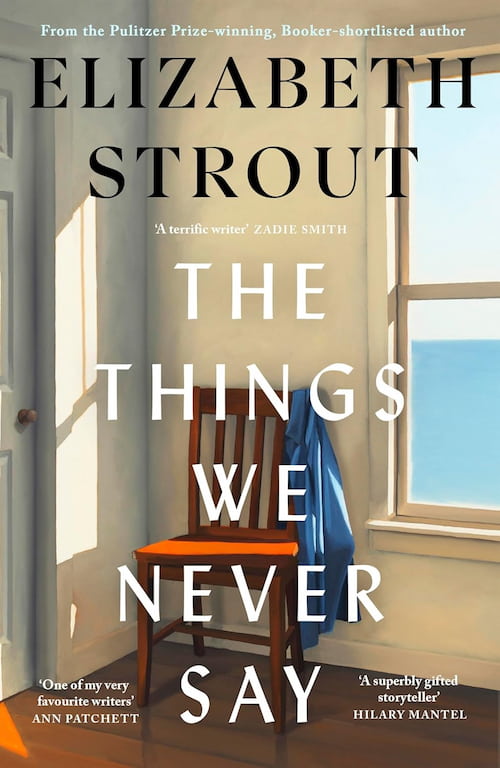
Volunteer book reviewer Lucy shares her thoughts on The Things We Never Say, a stunning novel about love, loneliness and new beginnings by Elizabeth Strout.
Interested in reading The Things We Never Say? You can borrow a copy from our online catalogue to be collected from any Suffolk library.
About The Things We Never Say
Artie Dam is a man with a secret.
He goes about his days teaching American history to high schoolers, correcting their casual ignorance, and lending a kind word to those who need it most. He spends his free time sailing the beautiful Massachusetts Bay, or with his adult son and his wife of more than three decades – and as Artie does these things, he plans the event that will forever change the world he inhabits.
But when a startling accident awakens a new perspective in Artie, and he realizes that life has its own secret it’s been keeping from him – along with a lot more to say on the weighty matters of fate and freedom in his home and his country – he charts another course full of grief, hilarity and heart, to a place where the end marks the beginning.
Please note: The Things We Never Say contains themes of grief and suicide.
Lucy’s Review
As the title suggests, the novel is preoccupied with the harbouring of secrets. Although several characters suffer both mentally and physically from their inability to articulate their inner lives, the narrative feels less concerned in advocating for frankness than in examining the forces that make expression so difficult. Strout is more interested in why people repress and in probing the limits of free will.
Strout deftly lifts the lids on her characters inner lives and delineates, with striking clarity, the ways in which interior tensions manifest in external lives. I enjoyed her depiction of the central marriage, in which both are practically suffocated by the unsayable; it was incisive and unsettling. Art’s relationship with his students also offered a fresh and novel perspective. Like in her previous novels, Strout seems drawn towards teachers, particularly ones who take an interest in their students on a human-level and vehemently stamp out bullying.
Although I enjoyed the myriads of characters and storylines, and how they often interlinked, I was brought out of myself a few times. It did feel at times that perhaps misfortune was being relentlessly mined as a plotline to explain why the characters were so tortured. Also, although the novel offers an insightful glimpse into the current American political climate, it does not, at least from my perspective, articulate anything particularly novel about the deepening divisions or the emotional volatility surrounding them.
Strout writes in her typical minimal and stripped back style, rarely sparing a moment on rich or indulgent descriptions (apart from the sparkling Massachusetts’ seascape at the very beginning). The narrator appears as a hovering consciousness throughout the novel, observational one moment and then moralising or didactic the next. Strout also often contrasts flashbacks or glimpses into the future against current events, creating a disquieting effect and aligning her reader with the omnipresent narrator.
Recommendation: It’s definitely one to add to your reading list if you enjoy following the Booker Prize.
 English
  Polish
  Lithuanian
  Romanian
  Portuguese
  Bengali