


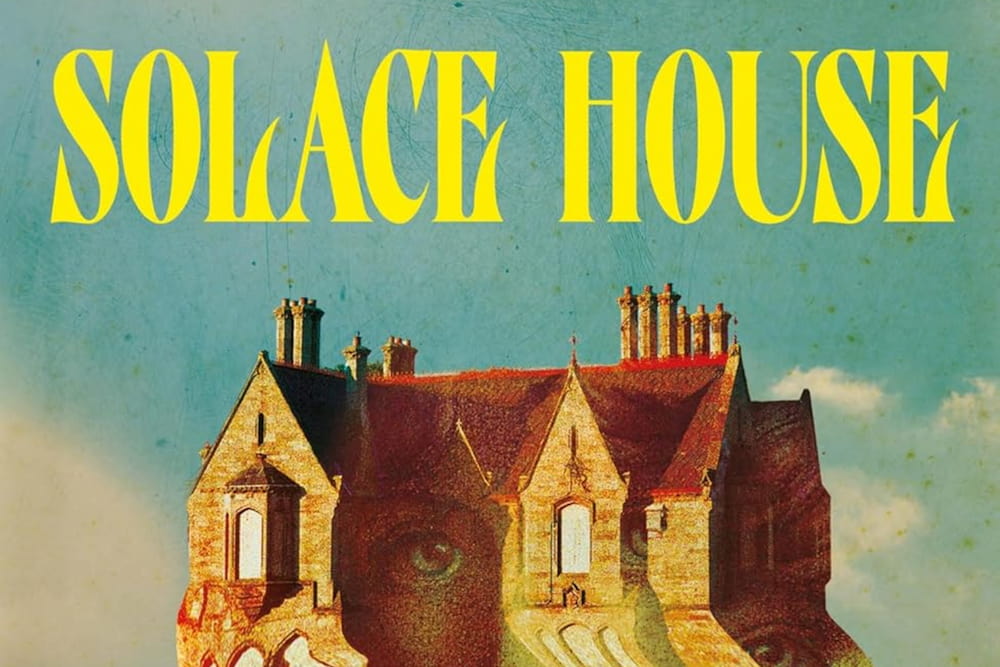
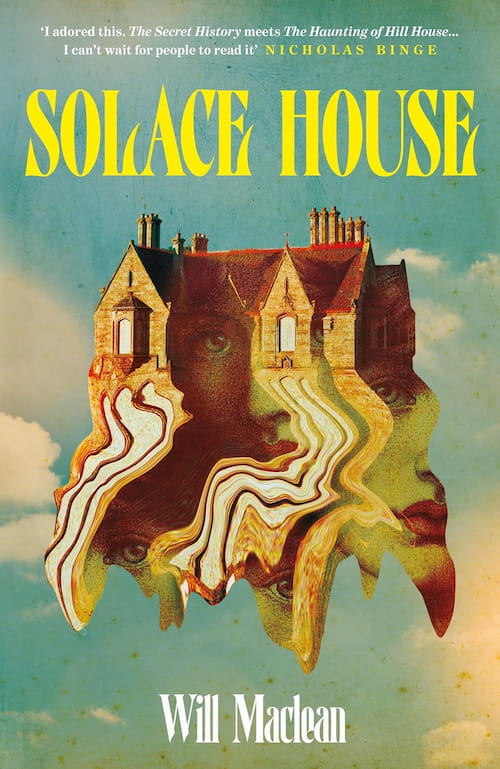
Volunteer book reviewer Lucy shares her thoughts on Solace House, a horror-filled mind-bending novel from author Will Maclean.
Interested in reading Solace House? You can borrow a copy from our online catalogue to be collected from any Suffolk library.
About Solace House
In the summer of 1993, broke student Alex Lane joins a team clearing out Solace House, a Victorian mansion bequeathed to the university by a reclusive hoarder called Flayne. The other students are a mixed bunch, but Alex quickly falls into a close friendship with the lively, redheaded Ella.
When the crew begins sorting through piles of junk, they stumble upon Flayne’s journals, in which he details his obsession with his missing mother, his discovery of a place called Bewise, and – most mysteriously – his belief in another realm lying parallel to ours, along with coded instructions as to how it might be reached.
As the students delve deeper into the house’s secrets, one of them becomes obsessed with deciphering Flayne’s strange opus and its promise of another world… and they may be willing to sacrifice everything, and everyone, to get there.
Lucy’s Review
Will Maclean’s novel throws a multitude of different allusions together, which is not a criticism; it’s one of the main aspects of the novel I enjoyed.
The resulting hodgepodge of themes ranges from mental deterioration, magical realms, preternatural creatures, psychedelic drugs, straight-up gore, time slips, trepanning, and even Neolithic ceremonies. Maclean’s maximalist approach is paying homage to the Gothic, which one of his characters explains is the true prerogative of the genre.
The novel is also packed with references to art and literature. At times, I wondered whether Maclean was simply doing a spin-off of Genesis, filtered through a psychedelic, “time is an illusion” lens, with the allusions to Adam, Abel, and paradise hardly making this leftfield.
The novel also features poetry, written in a lofty, Milton-esque style, which eventually reveals a great word-play puzzle. And there’s also Richard Dadd’s The Fairy Feller’s Master Stroke, which crops up repeatedly. Maclean emphasises the way Dadd kept reworking the painting almost to the point of abstraction, a detail that feels like another admission of the novel’s tendency to pile things on.
Despite this, a perhaps slightly frustrating aspect of the novel is that Maclean denies a completely conclusive ending. Instead, it has the sort of feel that if you read it again, you would find an endless mine of clues and allusions which perhaps hold the secret to the mystery. I would also argue that the female characters are a little underdeveloped and the setting is more reminiscent of an American summer camp, rather than a British university, but the remote campus of St Andrews also sprung to mind while reading.
Despite these hang-ups, I really do want to emphasise how much I enjoyed it. While reading I became quite obsessed and devoured it within two days, despite its hefty 500-page count.
Recommendation: If you’re looking for a slightly more unconventional horror, or even a campus mystery, for this October, then look no further.
 English
  Polish
  Lithuanian
  Romanian
  Portuguese
  Bengali